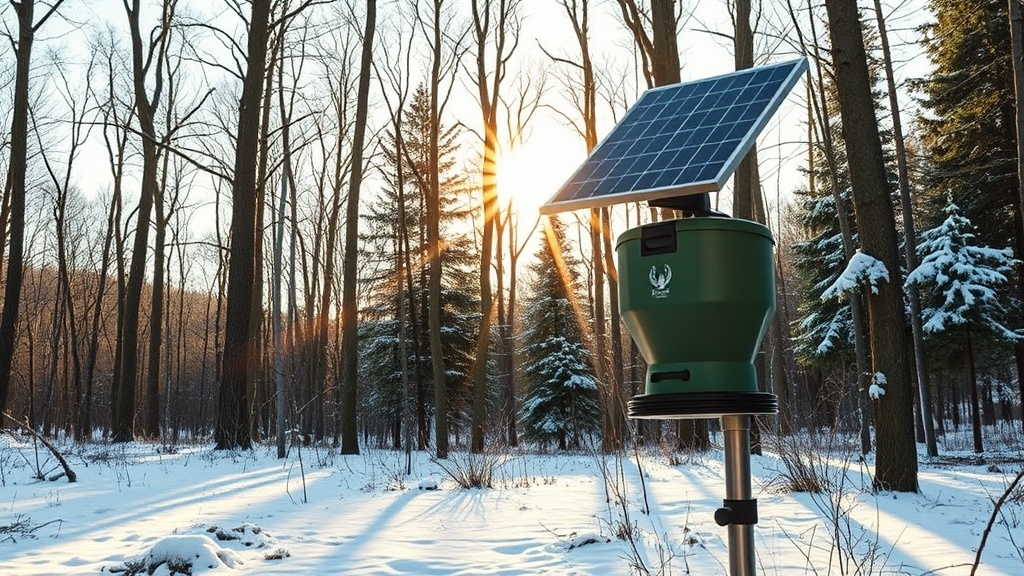
Why does the solar panel angle matter for the BuckGuide 300lb Spin-Cast Feeder?
The BuckGuide 300lb Spin-Cast Feeder is engineered to dispense up to 300 lbs of corn or pellets with reliable precision, but its entire operation depends on a steady 12V battery charge from a solar panel. If the solar panel is mounted at the wrong angle, especially during winter months when the sun is low, you risk battery drain and feeder downtime. A suboptimal angle can reduce energy harvest by 20–40%, leading to motor stalls or skipped feeding cycles. Proper mounting ensures the panel receives direct sunlight for 6+ hours daily, keeping the battery topped off and the rotor spinning on schedule.
To maximize efficiency, account for your latitude and the feeder’s typical location (woodland edge vs. open field). The factory tilt bracket on most BuckGuide 300lb units allows 15° to 60° adjustments. Setting the angle within 10° of your latitude (plus 15° in winter) is a proven rule. For instance, at 40°N latitude in Michigan, a winter angle of 55° yields optimal exposure when the sun is at 25° elevation. This prevents the battery voltage from dropping below 12.4V during critical feeding hours.
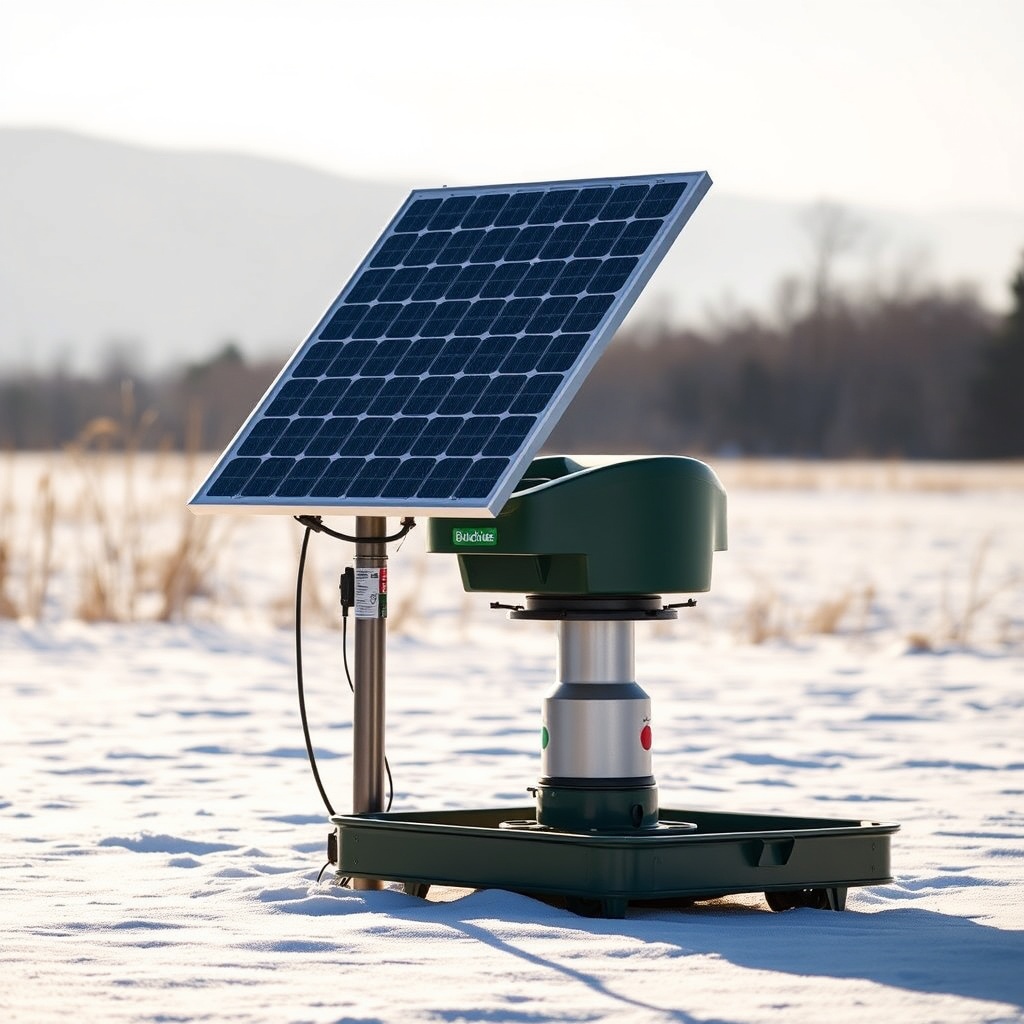
| Your Latitude (°N) | Summer Angle (April–Sept) | Winter Angle (Oct–March) | Year-Round Fixed Angle |
|---|---|---|---|
| 25° (South Texas, Florida) | 25° | 40° | 30° |
| 35° (Tennessee, Virginia) | 35° | 50° | 40° |
| 40° (Nebraska, Ohio) | 40° | 55° | 45° |
| 45° (Minnesota, Michigan) | 45° | 60° | 50° |
| 50° (Canada border) | 50° | 65° | 55° |
How does the season affect the ideal tilt for the BuckGuide 300lb feeder?
Seasonal sun paths change dramatically across the United States. In summer, the sun climbs higher (70°+ elevation at noon in southern states), so a flatter angle (matching your latitude) works well. In winter, the sun hovers near 20–30° elevation, meaning you need a steeper tilt to capture direct rays rather than reflecting off snow. The BuckGuide 300lb Spin-Cast Feeder’s battery, typically a sealed lead-acid or AGM 12V unit, charges most efficiently when the panel voltage exceeds 17V under load—achieved through correct tilt.
A common mistake is leaving the panel flat against the feeder top year-round. At 45°N latitude, a flat panel in December captures only 45% of available sunlight compared to a 60° tilt. That shortfall can drop the battery below 12.0V overnight, especially if the feeder disperses 6–8 seconds of corn twice daily. For consistent operation, adjust the tilt twice a year: spring (April) and fall (October). If you prefer a fixed angle, use the “latitude + 5°” rule—this gives 85–90% annual efficiency. Check our wiring guide to ensure polarity and gauge are correct for seasonal adjustments.
What is the optimal solar panel mounting angle for battery longevity?
Battery longevity on the BuckGuide 300lb Spin-Cast Feeder hinges on avoiding deep discharges below 50% state of charge. A lead-acid battery can handle only 300–500 cycles at 50% depth of discharge. If your panel angle is off, the battery cycles deeper and more frequently, shortening its life by up to 40%. The optimal mounting angle keeps the battery in a “float” state (13.2–13.8V) during daylight hours.
For maximum battery life, position the panel to face true south (not magnetic south, which varies by declination). Use a compass adjusted for +10° correction in the eastern U.S. A well-angled 10W panel on the BuckGuide 300lb delivers about 0.5–0.7 Ah per day in winter, matching the feeder’s draw of 0.4 Ah per feeding cycle. If you use a 20W panel, tilt becomes less critical, but still vital for cloudy days. Pair this with proper solar panel sizing to avoid chronic undercharging.
Can I use the BuckGuide 300lb feeder’s existing bracket for angle adjustment?
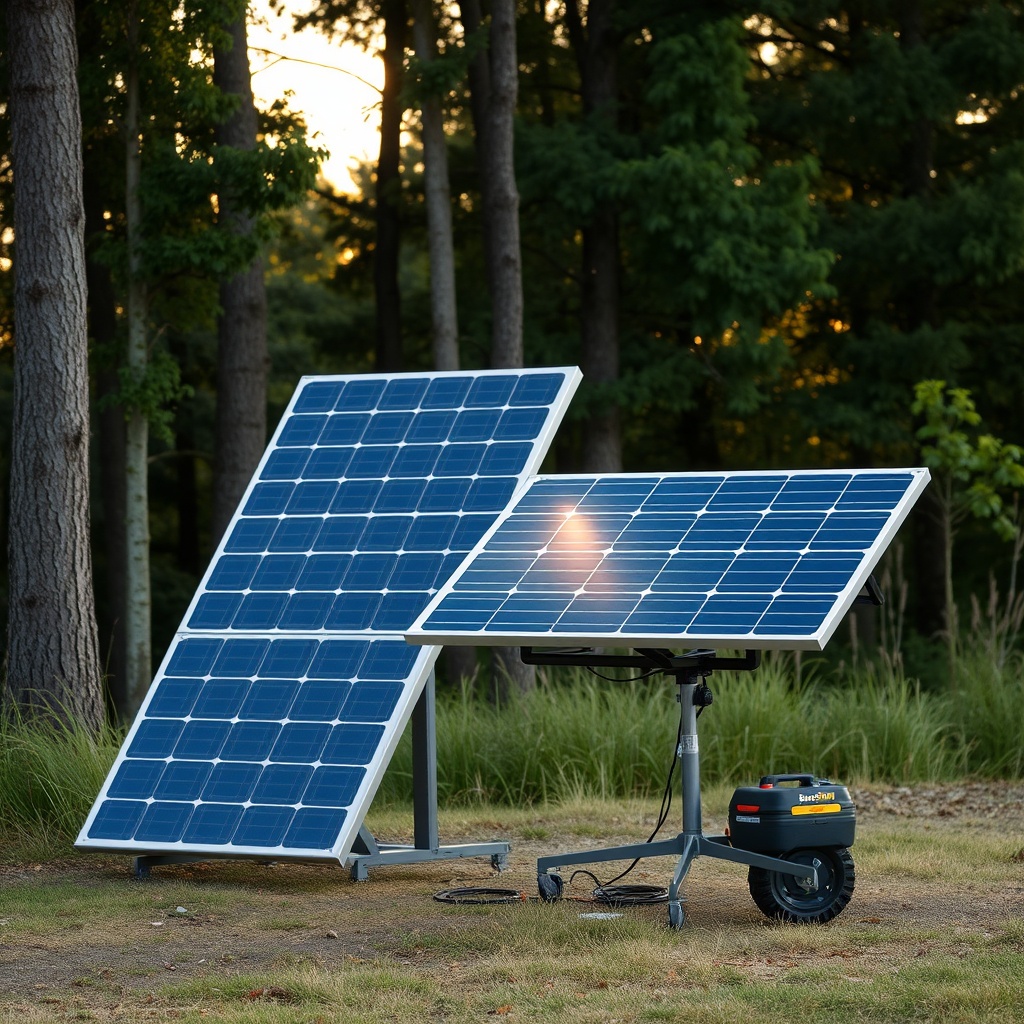
Yes—the factory bracket on the BuckGuide 300lb Spin-Cast Feeder includes a pivoting arm with locking pin holes spaced every 10°. This bracket supports panels up to 12 lbs (typical for 10–20W polycrystalline units). However, the standard bracket only allows 0°, 15°, 30°, 45°, and 60° positions. For finer tuning, you can add a short length of chain and a turnbuckle to create a custom angle between those detents.
If you mount the feeder on a tree or post, ensure the bracket is level laterally—a 5° tilt east or west reduces daily energy by 10–15%. A level bubble (included with some kits) helps. The bracket also serves as a ground plane for lightning discharge, so do not insulate it from the post. Over-tightening the locking bolt can strip the aluminum threads; use a torque wrench set to 8 Nm. For heavy snow loads, angle the panel steeper than 45° to shed accumulation—flat panels can collect 6+ inches of snow, blocking all charging.
How do trees and shadows affect the solar panel angle?
Shadows are the number-one enemy of solar charging on the BuckGuide 300lb Spin-Cast Feeder. Even a single branch casting a thin strip of shade across the panel can drop the output by 80% due to the “Christmas light effect” where shaded cells block the entire string. The optimal angle also depends on your feeder’s proximity to trees. In a deciduous forest, winter sun is lower, so a steeper angle (55° at 40°N) can help you tilt the panel above brush line.
Use a solar pathfinder or smartphone app to map shade at 9 a.m., noon, and 3 p.m. on the winter solstice. Remove any limbs within 15 feet of the panel path. If you cannot avoid morning shadow, face the panel slightly west of south (southwest by 10°) to capture afternoon sunlight. This compensates for earlier loss. The BuckGuide 300lb’s motor timer consumes 0.1A during the day, so even partial shading can cause erratic feeding. For persistent shade, upgrade to a squirrel-proof enclosure that also shields the panel from falling debris.
What tools and steps do I need to adjust the angle on site?
Adjusting the solar panel angle on a BuckGuide 300lb Spin-Cast Feeder requires minimal tools: a 10mm wrench, a Phillips screwdriver, a level, and a protractor (or angle finder app). First, disconnect the panel from the feeder to avoid short circuits. Loosen the two side bolts on the bracket pivot (do not remove fully). Tilt the panel to your desired angle—say 55° for a December installation in Wisconsin. Tighten bolts to 8 Nm, then check level in both axes.
Next, reconnect the wires per the color code (red positive, black negative). Observe the charge controller LED: green indicates bulk charging, yellow means float. If the LED is off, the angle may be too low or a wiring fault exists. For off-grid adjustments, carry a spare 2-foot MC4 extension cable—sometimes the panel must be repositioned further from the feeder to clear a tree. Test the feeder by triggering a manual spin cycle; the voltage should not dip below 12.0V during the rotor run. Refer to our motor spin troubleshooting guide if the timer fails after an angle change.
What BuckGuide 300lb Spin-Cast Feeder owners say
Long-time user Randy from Missouri (38°N) reports: “I set my panel at 45° year-round and never had a battery die, even in February snow. But my neighbor mounts his flat and he’s replacing 12V batteries every season.” Another owner, Diane in Montana (47°N), shares: “I used the latitude+15° trick for winter and my BuckGuide 300lb spins like a champ. The 20W panel kept the battery at 12.6V through two weeks of overcast.”
Several hunters on forums note the bracket’s limited fine-tuning: “I wish BuckGuide offered a 5° step instead of 10°,” says Mike from Ohio. “I ended up building a wooden shim for 43° tilt.” A common theme is that owners who check angle twice yearly see far fewer issues with wind resistance because the steeper angle reduces sail area. Most agree that the 300lb feeder is reliable when the solar setup is dialed in—angle adjustment is the single most impactful DIY improvement.
Frequently Asked Questions
1. What is the best solar panel angle for a BuckGuide 300lb feeder in a fixed location?
Set the panel to your latitude plus 5° for year-round use. Example: 40°N latitude → 45° fixed angle. This yields about 90% of maximum possible energy over the year.
2. How often should I adjust the solar panel angle?
Twice a year: transition to a steeper winter angle (latitude+15°) in early October, and back to a shallower summer angle (latitude) in early April. This maximizes both seasons without constant tweaking.
3. Will an incorrect angle damage the BuckGuide 300lb feeder battery?
Yes. Chronic undercharging from a poor angle causes sulfation and reduced capacity. Winter angles below 45° at 45°N latitude can halve battery life from 3 years to 18 months.
4. Can I mount the solar panel on a separate pole far from the feeder?
Yes. Use a 10-foot ground post and run 14 AWG solar cable up to 30 feet. Ensure the panel clears surrounding brush and faces south. This also helps with wind resistance—the feeder’s profile is less top-heavy.
5. Do I need a charge controller for the BuckGuide 300lb feeder solar panel?
Yes. The feeder’s built-in timer circuit expects a regulated 12V input. Use a PWM or MPPT controller (10A minimum) to prevent overcharging on sunny days. Most factory kits include one, but verify your model.
6. What if my solar panel angle is correct but the feeder still won’t spin?
Check the battery voltage with a multimeter. If below 12.0V, the panel may be shaded (even at the right angle). Also verify the wiring connections; a loose terminal mimics a voltage drop. If everything checks out, see our motor troubleshooting guide.