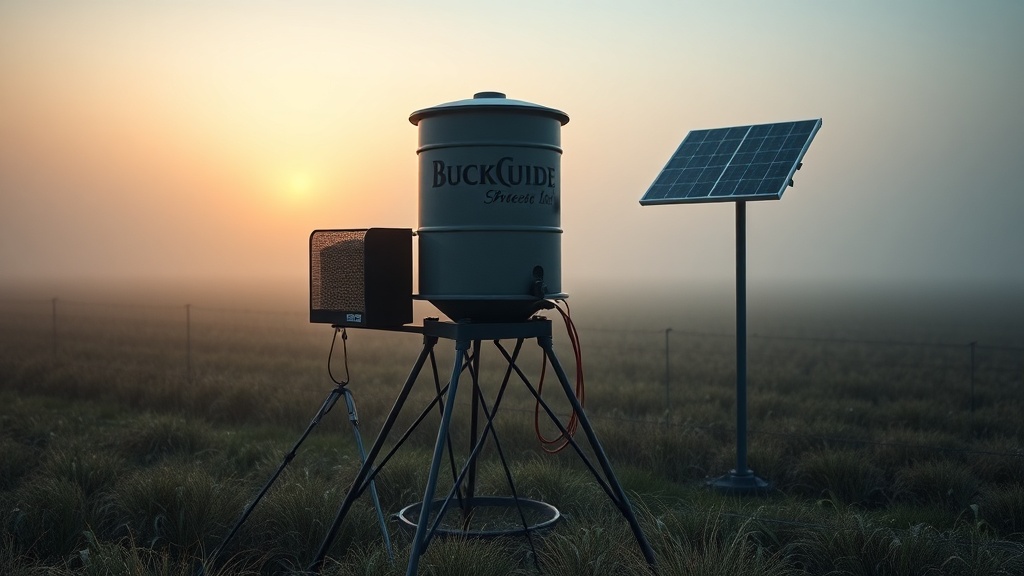
Why Does Battery Voltage Matter for the BuckGuide 300lb Spin-Cast Feeder?
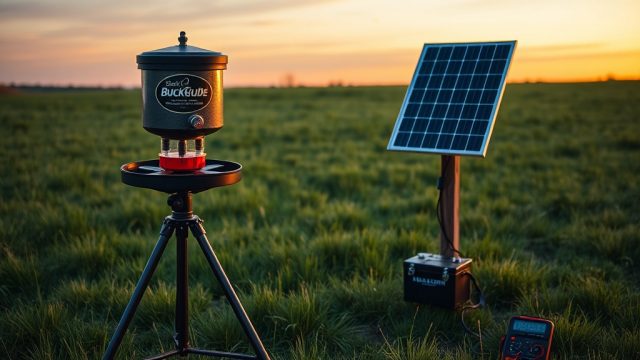
Managing battery voltage is critical for the BuckGuide 300lb Spin-Cast Feeder, especially when paired with a solar panel system. A drop below 12.4 volts under load can cause the motor to spin erratically, leading to inconsistent corn dispersal and wasted feed. In severe cases, voltage sag below 11.8 volts may prevent the timer from activating at all. Proper voltage optimization ensures the feeder throws corn precisely, even during cold dawn hours or after multiple overcast days.
This article focuses on battery-solar integration, providing actionable data to keep your BuckGuide 300lb Spin-Cast Feeder running at peak performance. For additional setup guidance, see our Remote Programming Guide for BuckGuide 300lb Spin-Cast Feeder.
What Is the Ideal Battery Voltage Range for Reliable Operation?
The BuckGuide 300lb Spin-Cast Feeder runs on a standard 12V deep-cycle battery. The ideal resting voltage range for consistent spin-cast throws is 12.6V to 12.8V (fully charged). Under load during a feeding cycle, voltage should not drop below 12.0V. If you measure 11.9V or lower while the motor is spinning, the feeder may stall or throw incomplete amounts.
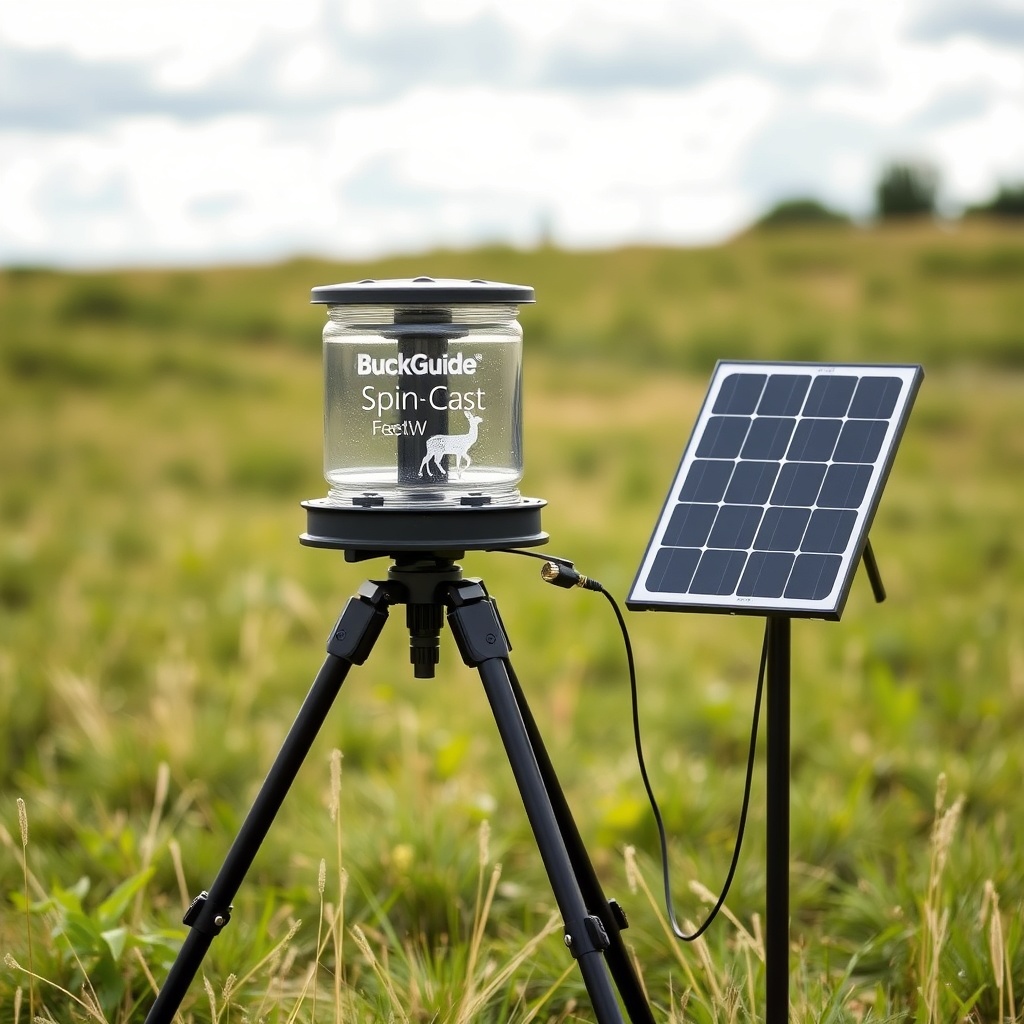
Severity table for battery voltage levels in the BuckGuide 300lb Spin-Cast Feeder:
| Voltage (Resting) | State of Charge | Feeder Performance | Action Required |
|---|---|---|---|
| 12.6V – 12.8V | 100% | Optimal spin-cast throw distance | None |
| 12.4V – 12.5V | 75% | Good, but voltage sag may affect timer | Check solar charge controller |
| 12.0V – 12.3V | 50% | Shorter throws; possible missed cycles | Recharge or add larger solar panel |
| 11.8V – 11.9V | 25% | Motor struggles; feeding may skip | Immediate recharge; inspect battery age |
| Below 11.8V | Discharged | Feeder may not activate at all | Replace battery or use AC charger |
Note: Always measure voltage with a multimeter at the feeder’s battery terminals after the unit has rested for 30 minutes with no load. If you encounter issues, explore our Troubleshooting Common Issues with BuckGuide 300lb Spin-Cast Feeder.
How Does Solar Panel Wattage Affect Charging Efficiency?
Solar panels for the BuckGuide 300lb Spin-Cast Feeder should provide enough current to replace daily draw while accounting for clouds and shorter winter days. A 10W panel is adequate for a single feeding per day in sunny regions, but if you run two feedings (morning and evening) or live in a shaded area, upgrade to a 20W or 30W panel. The charge controller must be compatible with the panel’s voltage output—typically a PWM type for 12V systems.
Key factors for solar charging:
- Ampere-hour draw: Each spin-cast cycle draws 2–3Ah from the battery depending on duration (default 6–10 seconds).
- Sunlight hours: Aim for a panel that can replenish at least 1.5x daily consumption. For two cycles, that’s roughly 6–9Ah needed per day.
- Panel placement: Orient south (in the northern hemisphere) with no shadow between 10 a.m. and 3 p.m.
- Wiring gauge: Use 14 AWG or thicker for runs over 15 feet to avoid voltage drop.
A 20W monocrystalline panel typically produces 1.1–1.3A in full sun, which can fully recharge a 12V 7Ah battery in 6–8 hours. For larger batteries (e.g., 18Ah deep-cycle), a 30W panel is recommended. Compare feeder options with our BuckGuide 300lb vs Moultrie Pro Hunter: Which Feeder Has Better Timer Accuracy?.
What Are the Best Battery Types for This Feeder?
Three battery types commonly pair with the BuckGuide 300lb Spin-Cast Feeder: sealed lead-acid (AGM), gel, and lithium iron phosphate (LiFePO4). AGM batteries are popular due to low cost and good performance in cold weather, but they self-discharge at ~3% per month. Gel batteries tolerate deeper discharges and handle vibration well, making them ideal for remote feeders. LiFePO4 offers the longest cycle life (2000+ cycles) and can discharge to 80% depth without damage, but costs 3–4 times more upfront.
Comparison table for battery types in the BuckGuide 300lb Spin-Cast Feeder:
| Battery Type | Avg. Price (12V 7Ah) | Cycle Life | Cold Weather Performance | Best For |
|---|---|---|---|---|
| AGM | £22 – £30 | 300–500 cycles | Good down to -10°C | Budget setups, moderate climates |
| Gel | £35 – £50 | 500–800 cycles | Excellent down to -20°C | Harsh winters, remote locations |
| LiFePO4 | £90 – £130 | 2000+ cycles | Fair; requires BMS heating below 0°C | Long-term, low-maintenance use |
For seasonal hunters, an AGM battery paired with a solar panel offers the best value. If you plan to run the feeder year-round without maintenance, LiFePO4 justifies the investment. After selecting your battery, consider converting your feeder to gravity feed for backup: read How to Convert Your BuckGuide 300lb Spin-Cast Feeder to a Gravity Feed System.
How Can You Test Voltage Drop Under Load?
Voltage drop under load reveals whether your battery can sustain the motor’s current spike. The BuckGuide 300lb Spin-Cast Feeder draws 3–5A during startup, dropping to 2A while spinning. To test, connect a multimeter set to DC voltage across the battery terminals while manually triggering the feeder (refer to your remote manual). Observe the lowest reading during the first second of spin. If it dips below 12.0V, your battery is weak or undersized.
Step-by-step test procedure:
- Ensure the feeder battery is fully charged (resting voltage at least 12.6V).
- Disconnect any solar panel to avoid interference.
- Press the test button on the BuckGuide controller or use the remote to activate a feed cycle.
- Read the voltage as the motor starts—note the lowest number.
- Repeat three times and average the result.
If the average load voltage is below 12.0V, replace the battery or add a capacitor bank to smooth startup current. For severe drops, inspect wiring connections for corrosion. Wind can also affect performance; review Wind Resistance Tips for BuckGuide 300lb Spin-Cast Feeder.
What Owners Say About Battery Life on the BuckGuide 300lb Spin-Cast Feeder
Experienced users report that with a quality 20W solar panel and a 12V 18Ah AGM battery, the BuckGuide 300lb Spin-Cast Feeder runs reliably for 4–6 months without intervention. One owner from Texas noted: “After two years, my original battery still holds 12.5V at rest if I clean the solar panel monthly.” Another from the UK mentioned: “I switched to a LiFePO4 battery last season—no more worrying about winter voltage sag at dawn.”
Common praise includes the feeder’s low parasitic draw (only 0.5mA in sleep mode) and the accuracy of the timer with stable voltage. Constructive feedback often focuses on the solar controller’s sensitivity to partial shading. Several owners upgraded to a 30W panel after moving the feeder to a wooded edge. For deeper performance comparisons, see How to Convert Your BuckGuide 300lb Spin-Cast Feeder to a Gravity Feed System.
Frequently Asked Questions
Q1: How often should I check the battery voltage on my BuckGuide 300lb Spin-Cast Feeder?
A: Check at least once a month during the hunting season, and weekly if you experience overcast weather for more than three days. Use a multimeter at the battery terminals after 30 minutes of rest.
Q2: Can I use a car battery with this feeder?
A: Yes, a standard 12V car battery works but is heavier and may sulfate if deep-discharged repeatedly. A deep-cycle battery is recommended for longevity.
Q3: Why does my feeder spin slowly even though the battery reads 12.4V?
A: The voltage may drop under load due to high internal resistance. Test under load as described above. Also check for loose or corroded connections.
Q4: What size solar panel do I need for two feedings per day?
A: A 20W panel is sufficient for most regions. In northern UK or Canada, a 30W panel ensures charging during short winter days.
Q5: Can I install a larger battery without modifying the feeder?
A: Yes, the BuckGuide 300lb Spin-Cast Feeder accepts up to a 12V 35Ah battery. Ensure the battery box is weather-sealed and anchored to prevent tipping.
Q6: How does cold weather affect the battery?
A: Lead-acid batteries lose about 20% capacity at -10°C. LiFePO4 batteries require a built-in heater for charging below 0°C. Use a gel battery for cold climates.