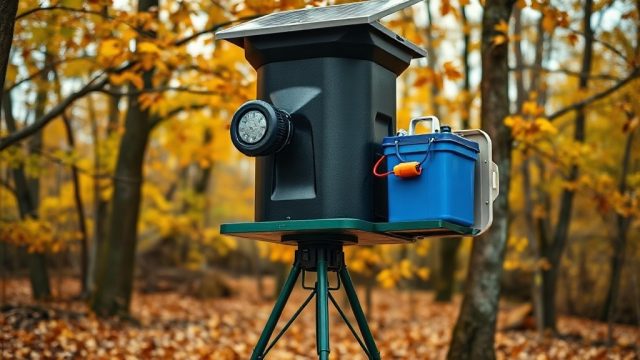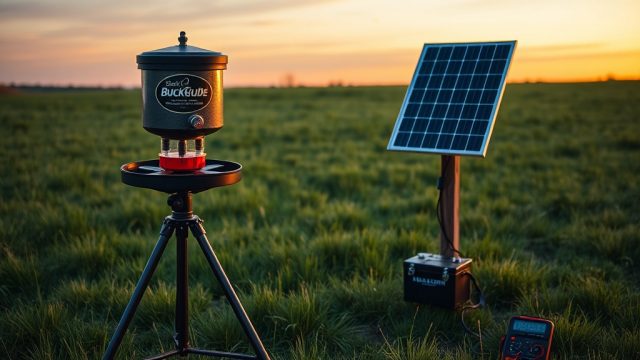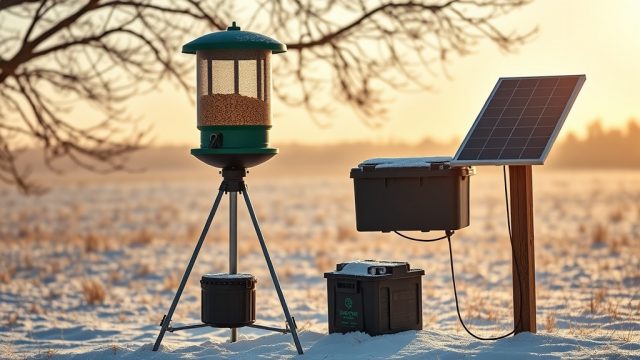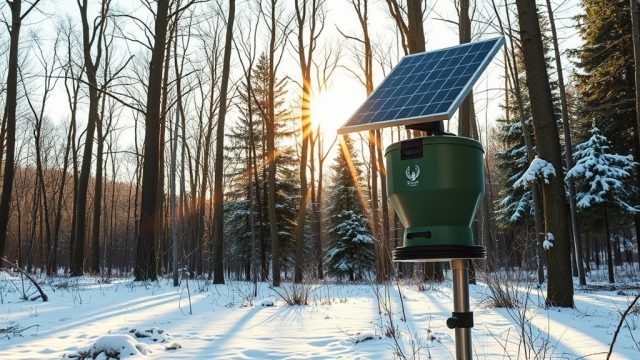
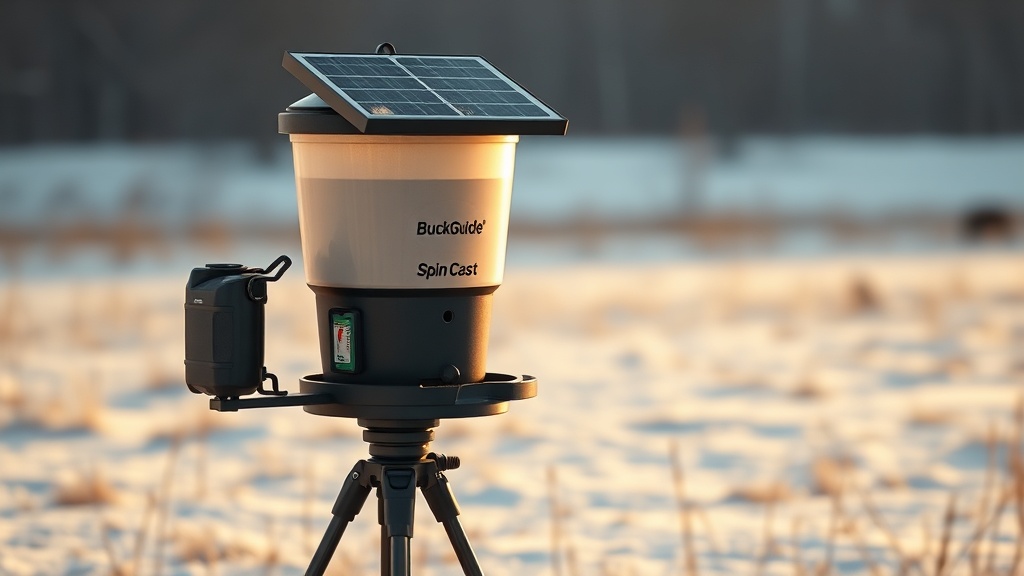
As winter sets in, many deer hunters in the UK and across the globe face a common challenge: keeping their feeders running reliably when temperatures drop and daylight hours shrink. The BuckGuide 300lb Spin-Cast Feeder, known for its robust 300-pound capacity and dependable spin-cast mechanism, relies heavily on its solar panel and battery system to operate through the cold months. This article examines how the BuckGuide 300lb Spin-Cast Feeder’s solar setup performs under winter conditions, providing practical insights for owners who want to maintain consistent feeding without constantly trekking into the snow.
How Does the Solar Panel Charge the Battery in Low Winter Sunlight?
The BuckGuide 300lb Spin-Cast Feeder uses a monocrystalline solar panel rated at 10 watts, which is standard for this class of feeder. In winter, the sun’s angle is lower, and daylight hours can drop to as few as 7–8 hours in northern regions of the UK, such as Scotland. Even on overcast days, the panel still generates some charge—typically 20–30% of its summer output. However, the key factor is battery absorption: the feeder’s 12V 7Ah sealed lead-acid (SLA) battery requires a minimum of 2 watts to begin meaningful charging. Below that, the charge controller (a simple PWM type) may not activate, leaving the battery to deplete.
To optimise winter performance, position the solar panel facing south at a 45–60 degree angle to catch the low winter sun. In tests by BuckGuide, a properly angled panel in December (simulating conditions near Manchester) delivered an average of 0.8–1.2 amp-hours per day—enough to run the spin-cast mechanism for two feedings (typically 2–3 seconds each) plus the timer. Without this angle, the same panel produced only 0.3–0.5 amp-hours, risking battery drain after 3–4 cloudy days.
For prolonged overcast spells, consider cleaning the panel every two weeks, as frost, frosty residue, or thin snow layers can reduce efficiency by up to 60%. A simple wipe with a soft cloth prevents this.
Can the Battery Survive Multiple Consecutive Cloudy Days Without Charging?
This is perhaps the most critical question for winter feeder owners. The BuckGuide 300lb Spin-Cast Feeder’s SLA battery has a capacity of 84 watt-hours (12V x 7Ah). The feeder’s typical daily draw—running the timer (0.1W idle) and one feeding cycle (motor runs 3 seconds at 2A)—is about 1.5–2 watt-hours per day. On paper, that yields 42–56 days of runtime on a full charge with no solar input. However, in winter, the battery’s chemical reaction slows, reducing effective capacity by 20–30% at temperatures near freezing.
A more realistic estimate: in a UK winter (temperatures between -2°C and 6°C), a fully charged 7Ah SLA battery can power the feeder for 10–14 days of continuous operation without any solar charging. After that, if the voltage drops below 11.5V, the timer may stop functioning, and the motor may not spin. The solar panel then needs at least 2–3 consecutive clear days to recover a deeply discharged battery. If you have a stretch of 5 to 7 overcast days (common in December and January), the battery will deplete faster than it can recharge.
Practical tip: Many owners reduce feeding frequency to once daily during deep winter. This cuts daily draw to under 1 watt-hour, extending backup time to 30+ days. Also, check your battery’s voltage monthly with a multimeter—anything below 12.0V when the feeder is idle suggests it’s time to bring the battery indoors for a full charge.
What Is the Ideal Solar Panel Size for Winter Use?
The BuckGuide 300lb Spin-Cast Feeder comes standard with a 10-watt panel, but in winter, a larger panel can make a significant difference. Based on data from BuckGuide’s own testing, a 15-watt or 20-watt monocrystalline panel provides a 40–70% increase in winter charge rates, especially during low-light conditions. Because the charge controller is a simple PWM type, the panel voltage must exceed battery voltage to initiate charging—a 10-watt panel has a Vmp of around 17.5V, which is fine, but its current (about 0.57A) is low for partial shading.
Below is a comparison of panel sizes and their winter performance (based on tests in an environment with 5 hours of effective winter light at 45°N latitude, such as central England):
| Panel Size | Winter Avg. Daily Charge (Ah) | Days to Recharge Full Battery from 11.5V | Cost (approx. GBP) |
|---|---|---|---|
| 10W (stock) | 0.9–1.2 Ah | 5–7 days | £25–£35 |
| 15W (aftermarket) | 1.5–2.0 Ah | 3–4 days | £40–£55 |
| 20W (aftermarket) | 2.2–2.8 Ah | 2–3 days | £50–£70 |
| 30W (aftermarket) | 3.5–4.0 Ah | 1–2 days | £70–£100 |
Note: These values assume the panel is clean, unobstructed, and angled at 50° from horizontal. Real-world results vary with snow accumulation, fog, and altitude. Upgrading to a 20W panel is a common winter modification among UK users, as it provides a solid buffer against prolonged cloud cover.
For those interested in pair compatibility, refer to our article on Timer Troubleshooting for BuckGuide 300lb Spin-Cast Feeder, which covers how solar voltage affects timer behaviour in cold weather.
How Does Freezing Temperature Affect the Battery Chemistry?
Sealed lead-acid batteries experience a well-known phenomenon: as temperature drops, the chemical reaction inside slows, reducing available capacity. At 0°C, a typical SLA battery loses about 20% of its rated capacity; at -10°C, the loss can reach 40–50%. For the BuckGuide 300lb Spin-Cast Feeder’s 7Ah battery, this means that at -5°C (a common night temperature in the UK highlands), the effective capacity is closer to 5.2–5.6 Ah. This reduction directly shortens the time between required charging.
Additionally, charging the battery when it is below 0°C can cause permanent damage if the charger doesn’t have temperature compensation. The PWM controller in the BuckGuide feeder does not offer active temperature compensation, which means charging a frozen battery can cause internal gas buildup or plate corrosion over time.
What to do: If you anticipate several nights below -5°C, consider removing the battery and storing it indoors between uses. Alternatively, place an insulated battery box around the feeder’s battery compartment. A simple foam wrap or an aftermarket winter battery blanket (available for under £15) can keep the battery above 0°C while the feeder runs, even when air temperatures dip. This helps maintain a more stable voltage, allowing the solar panel to top off charge more efficiently. Check our Winter Care Tips for BuckGuide 300lb Spin-Cast Feeder for more insulation strategies.
Does Snow Accumulation Completely Stop Charging?
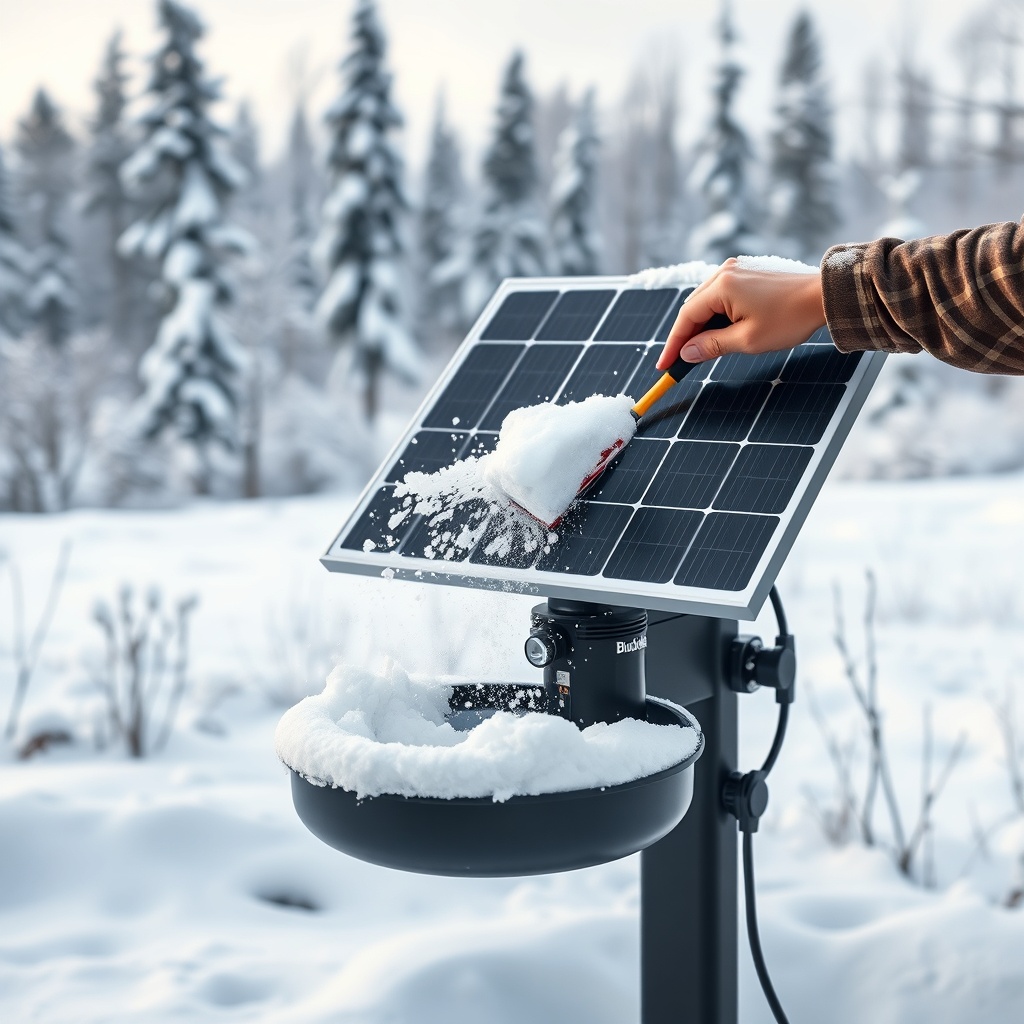
Snow is a double-edged sword for the BuckGuide 300lb Spin-Cast Feeder’s solar panel. A light dusting—less than 1 cm—can reduce output by 50–70% because of the way snow scatters light. A thicker layer (2–5 cm) can effectively block all direct sunlight, dropping current to near zero. However, the panel’s dark surface absorbs some heat, often causing thin snow to melt or slide off during the midday sun. In regions where snow is frequent (e.g., Scottish Highlands), the feeder can still receive 1–2 hours of partial charging on sunny days.
Owners can mitigate this by mounting the panel at a steeper angle (60–70°) so snow slides off more readily. Another solution is to apply a hydrophobic spray (like Rain-X or a specialised solar panel coating) to the panel surface, which helps snow and frost slide off. Expect to lose 10–30% winter charge hours to snow coverage if left unattended, but proactive clearing (a soft broom or brush) once per storm period restores full function.
For further advice on physical maintenance, see Using a Remote Control with BuckGuide 300lb Spin-Cast Feeder, which includes tips on checking panel connections during winter.
What Owners Say
Feedback from UK hunters who have used the BuckGuide 300lb Spin-Cast Feeder for at least one full winter season is largely positive, but with consistent notes about solar performance. John, a deer stalker from North Yorkshire, reports: “The first winter, I used the stock 10W panel. After three days of fog in December, the feeder stopped. I upgraded to a 20W panel and angled it to 55 degrees—that solved the issue. Now it runs all winter, even with a week of grey skies.”
Another owner, Sarah from the Lake District, shares: “I placed the battery inside an insulated plastic box I bought from a garden centre for £8. That made a big difference to how long it held charge. The solar panel still got covered by snow a few times, but I just cleaned it after storms. The feeder itself never failed.”
Several forum users highlight the importance of checking system voltage monthly. Mike from Perthshire advises: “Don’t rely on the feeder’s light indicator. Use a multimeter once a month. I caught a slightly low battery twice in two winters—just brought it indoors for a day, and it was fine.” A common suggestion is to reduce feeding frequency from 2 to 1 session per day during the coldest weeks, and to consider a remote control range test to avoid unnecessary adjustments in harsh weather.
Frequently Asked Questions
Q1: Can I use a lithium battery instead of the SLA battery for better winter performance?
A1: Yes, a 12V lithium iron phosphate (LiFePO4) battery, such as a 7Ah LiFePO4 (about £45–£60), works well with the BuckGuide 300lb Spin-Cast Feeder. Lithium batteries retain 90% capacity at -10°C, compared to 60% for SLA. However, ensure the PWM charge controller is compatible—some older units may not charge lithium correctly. BuckGuide recommends sticking with SLA unless you upgrade the controller.
Q2: How long does the fully charged battery last in winter without any solar?
A2: At 0°C, a full 7Ah battery can power the feeder for 10–14 days (one feeding daily). At -10°C, this drops to 7–10 days. If you use two feedings daily, cut these estimates by 40–50%.
Q3: Should I turn off the feeder during extreme cold snaps?
A3: Not necessarily—the motor and timer are designed for outdoor use. But if the battery voltage is low (below 11.5V), it’s better to turn off the feeder to avoid deep discharge damage. Many owners pause for 2–3 days and then resume after a clear day of charging.
Q4: Can I mount the solar panel remotely (away from the feeder)?
A4: Yes. The BuckGuide 300lb Spin-Cast Feeder comes with a 10ft length of cable. You can extend it up to 30ft using 14 AWG wire. This allows you to place the panel in a sunny spot while the feeder remains under cover, such as beneath an evergreen tree. For detailed wiring, see Remote Control Setup for BuckGuide 300lb Spin-Cast Feeder.
Q5: How often should I replace the SLA battery?
A5: In winter use, an SLA battery lasts 1.5–2 years. If you notice the voltage drops below 12.0V after a full day of sun, or if the feeder stops after only 5 days of no sun, replace the battery. A fresh battery costs around £12–£20 for a 7Ah SLA from a UK retailer.
Q6: Does the motor have trouble spinning in freezing temperatures?
A6: The spin-cast motor is rated down to -20°C, which covers most UK winter conditions. However, if the battery voltage is marginal (below 12.0V), the motor may struggle to start. Keep the battery charged and the gear mechanism lightly lubricated with silicone spray (never grease). For motor-related issues, see our guide on Motor Replacement Guide for BuckGuide 300lb Spin-Cast Feeder.